Introduction: Why Your 23 Month Old’s Sleep Schedule Matters
At 23 months old, your toddler is on the brink of turning two—a milestone that brings exciting developmental leaps but also potential sleep challenges. Establishing a consistent 23 month old sleep schedule isn’t just about getting more rest (though that’s certainly a benefit); it’s crucial for your child’s physical growth, cognitive development, and emotional regulation.
Most 23-month-olds need between 12 to 14 hours of total sleep per 24-hour period, including 10-12 hours at night and 1.5-2.5 hours of daytime sleep. However, every child is unique, and understanding your toddler’s individual sleep cues is just as important as following the clock.
In this comprehensive guide, you’ll find evidence-based wake windows for 23 month olds, printable sample schedules, bedtime routine strategies, and solutions to common sleep challenges—all designed to help your family get the rest you need.
Understanding 23 Month Old Sleep Needs
How Much Sleep Does a 23 Month Old Need?
According to pediatric sleep experts and the American Academy of Pediatrics, here’s what your 23-month-old requires :
Table
| Sleep Component | Recommended Duration |
|---|---|
| Total Daily Sleep | 12-14 hours |
| Nighttime Sleep | 10-12 hours |
| Daytime Sleep (Nap) | 1.5-2.5 hours |
| Number of Naps | 1 midday nap |
| Wake Windows | 5.25-5.75 hours |
Key Insight: While these are averages, some 23-month-olds may thrive on slightly more or less sleep. Watch your toddler’s mood and energy levels—they’re the best indicators of whether your current schedule is working.
The Science Behind Wake Windows for 23 Month Olds
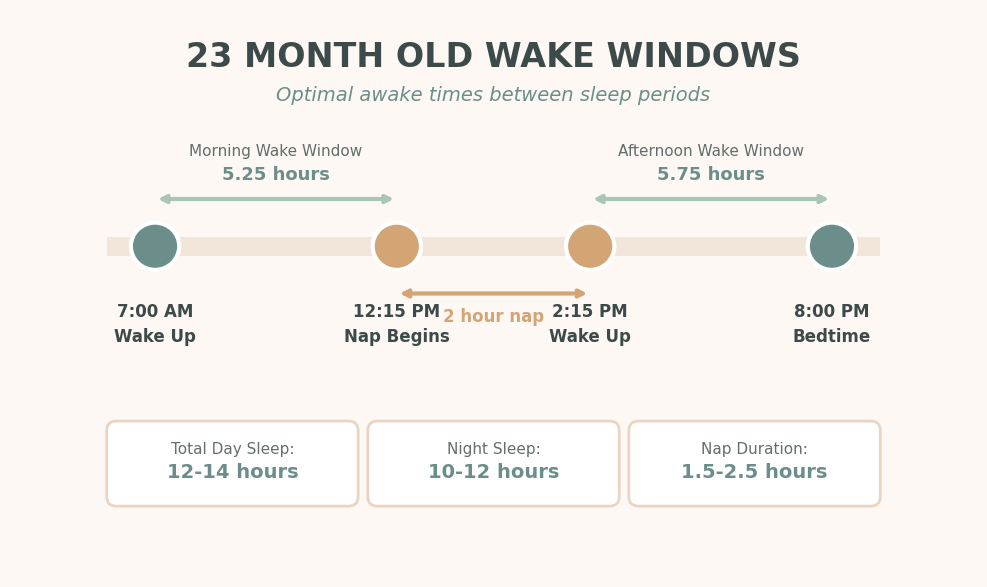
Wake windows are the periods your toddler stays awake between sleep sessions. At 23 months, most children can comfortably stay awake for 5 hours 15 minutes to 5 hours 45 minutes between waking up and their nap, and again between their nap and bedtime.
Going beyond these windows triggers cortisol and serotonin release—stress hormones that make it harder for your toddler to settle and stay asleep. Conversely, putting your child to bed before they’ve built sufficient “sleep pressure” can lead to bedtime resistance and frequent night wakings.
Pro Tip: The wake window before bedtime is often slightly longer than the morning window, as your toddler builds more sleep pressure throughout the day.
Optimal 23 Month Old Sleep Schedule: Sample Routines
Sample Schedule 1: The Standard Routine (7:00 AM Wake)
This is the most common 23 month old sleep schedule that works for families with early risers :
Table
| Time | Activity | Notes |
|---|---|---|
| 7:00 AM | Wake Up | Consistent wake time anchors the schedule |
| 7:30 AM | Breakfast | Include protein for sustained energy |
| 9:30 AM | Morning Snack | Light, healthy options |
| 12:15 PM | Nap Time | 5.25 hours awake time |
| 2:15 PM | Wake from Nap | 2-hour nap duration |
| 2:30 PM | Lunch | Post-nap meal prevents early waking |
| 5:00 PM | Dinner | Allow 2+ hours before bedtime |
| 6:30 PM | Bedtime Routine Begins | Bath, pajamas, books |
| 8:00 PM | Lights Out | 5.75 hours awake time after nap |
Sample Schedule 2: Early Riser Adjustment (6:30 AM Wake)
For toddlers who naturally wake earlier, this 23 month old nap schedule prevents overtiredness :
Table
| Time | Activity |
|---|---|
| 6:30 AM | Wake Up |
| 7:00 AM | Breakfast |
| 11:30 AM | Nap Begins (5 hours awake) |
| 1:30 PM | Wake from Nap (2-hour nap) |
| 6:30 PM | Bedtime Routine |
| 7:30 PM | Asleep (6 hours awake after nap) |
Sample Schedule 3: Short Nap/Early Bedtime Fallback
When your 23-month-old takes a shorter nap, adjust bedtime earlier to prevent overtiredness :
Table
| Time | Activity |
|---|---|
| 7:00 AM | Wake Up |
| 12:15 PM | Nap Begins |
| 1:45 PM | Wake from Nap (1.5-hour nap) |
| 6:45 PM | Bedtime Routine |
| 7:30 PM | Asleep (5.75 hours awake after nap) |
Important: If your toddler skips their nap entirely, aim for a 6:00-6:30 PM bedtime to compensate for lost daytime sleep.
Building the Perfect Bedtime Routine for Your 23 Month Old
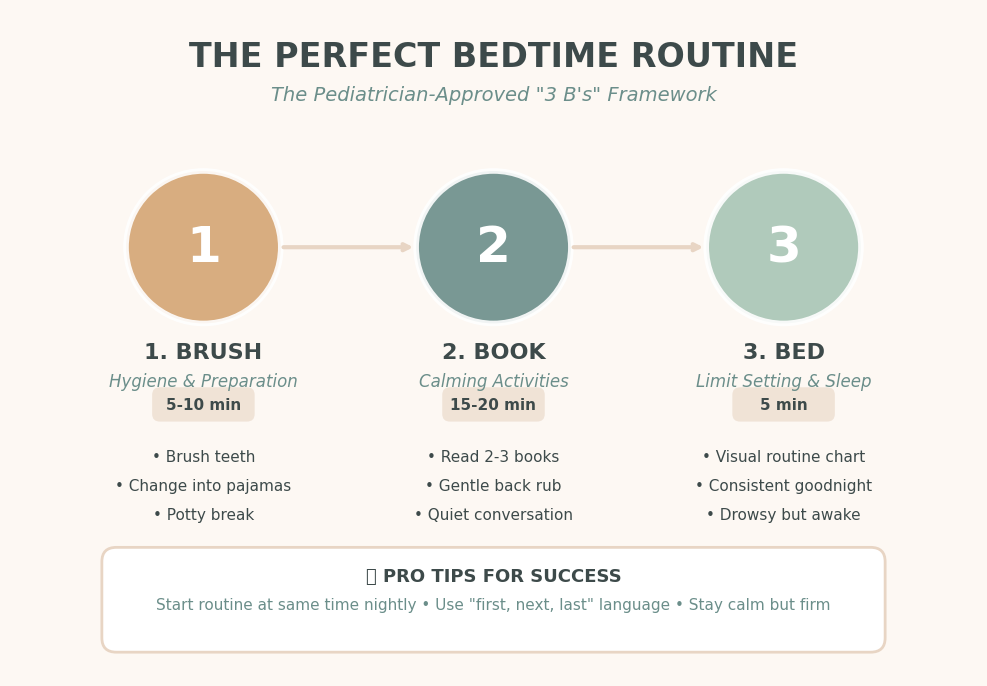
The Pediatrician-Approved “3 B’s” Framework
Sleep experts recommend structuring your 23 month old bedtime routine around three core elements :
1. Brush — Hygiene & Preparation (5-10 minutes)
- Brush teeth (use toddler-safe toothpaste)
- Change into comfortable pajamas
- Final potty break (if potty training)
- Avoid: Bottles or milk at bedtime (tooth decay risk)
2. Book — Calming Activities (15-20 minutes)
- Read 2-3 board books together
- Gentle back rub or massage
- Quiet conversation about the day
- Benefit: Promotes secure attachment and language development
3. Bed — Limit Setting & Transition (5 minutes)
- Use visual routine charts showing “first, next, last”
- Consistent goodnight phrase
- Place in crib drowsy but awake
- Key: This teaches self-soothing skills
Managing Bedtime Resistance at 23 Months
At this age, limit-testing is developmentally normal. Your toddler may request “just one more book,” run away during pajama time, or throw tantrums at the crib.
Expert Strategies:
- Stay consistent: Follow the same sequence every night
- Offer limited choices: “Which pajamas—blue or red?”
- Use visual timers: “When the sand runs out, we turn off the light”
- Remain calm but firm: Your consistency builds their security
Reddit Parent Insight: “We use ‘first, next, last’ language. ‘First we brush teeth, next we read books, last we turn out the light.’ It cut our bedtime battles in half.”
Nap Time Strategies for 23 Month Olds
How Long Should a 23 Month Old Nap?
Most 23-month-olds nap for 1.5 to 2.5 hours daily. The ideal nap duration depends on your child’s nighttime sleep:
- Long night sleepers (11-12 hours): Often take shorter naps (1.5 hours)
- Shorter night sleepers (10 hours): Usually need longer naps (2-2.5 hours)
Critical Rule: Cap naps at 3 hours maximum to protect nighttime sleep.
What Time Should a 23 Month Old Nap?
The optimal 23 month old nap time typically falls between 12:00 PM and 1:00 PM, depending on wake time. Aim for:
- 5-5.5 hours after morning wake-up
- At least 5 hours before intended bedtime
Pro Tip: Serve lunch before the nap rather than after. This prevents early waking due to hunger and helps your toddler settle more easily.
Handling Nap Resistance at 23 Months
Many parents report their 23-month-old suddenly fighting naps. This is often temporary and linked to:
- Developmental leaps (language explosion, motor skills)
- Testing boundaries and independence
- FOMO (fear of missing out) on activities
What to Do:
- Continue offering the nap daily—most children need naps until age 3+
- Implement “quiet time”: 60-90 minutes in the crib even if they don’t sleep
- Adjust timing: Try 15-30 minutes later if resistance persists
- Check wake windows: Ensure sufficient sleep pressure has built
Expert Note: “Even if they don’t fall asleep, quiet time gives them space to recharge—and gives you a break too!”
Common 23 Month Old Sleep Challenges & Solutions
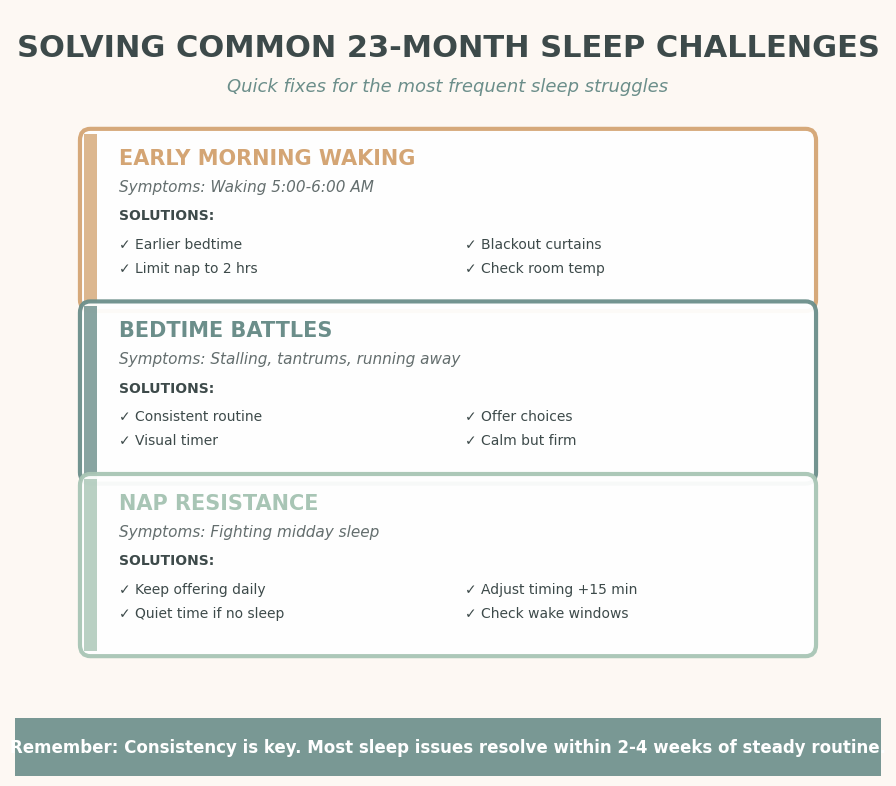
The 2-Year Sleep Regression (Can Start at 23 Months)
While not every child experiences a regression at exactly 24 months, many 23-month-olds show signs including :
- Bedtime battles and stalling
- Night wakings after months of sleeping through
- Early morning wake-ups (5:00-6:00 AM)
- Nap resistance or short naps
Causes:
- Separation anxiety peaks
- Mastering new skills (jumping, climbing, sentences)
- Increased independence and limit-testing
- Life changes (new sibling, potty training, daycare transition)
Solutions:
- Maintain consistency: Don’t introduce new sleep crutches
- Offer extra comfort: Brief check-ins are okay, but avoid co-sleeping if that’s not your goal
- Adjust schedule: Slightly later bedtime (15-30 minutes) may help
- Stay patient: This phase typically passes within 2-6 weeks
Early Morning Wakings (5:00-6:00 AM)
If your 23-month-old is waking too early:
- Check bedtime: Overtiredness often causes early waking—try an earlier bedtime
- Limit nap length: Ensure daytime sleep isn’t exceeding 2.5 hours
- Use blackout curtains: Early morning light triggers wakefulness
- Implement “ok-to-wake” clocks: Teach them when it’s acceptable to start the day
Night Wakings and Calling for Parents
At 23 months, night wakings are often behavioral rather than physical needs :
- Respond consistently: Brief, boring check-ins
- Avoid picking up: Unless genuinely distressed
- Use verbal reassurance: “You’re safe, it’s time to sleep, I love you”
- Check for discomfort: Teething, illness, or room temperature issues
Optimizing Sleep Environment for 23 Month Olds
Room Setup Essentials
Table
| Element | Recommendation |
|---|---|
| Temperature | 68-72°F (20-22°C) |
| Lighting | Blackout curtains for naps and night |
| Sound | White noise machine (50 dB or lower) |
| Crib Safety | Maintain crib until climbing out begins |
| Sleep Sack | Optional for warmth and security |
Screen Time Rules
The American Academy of Pediatrics recommends no screens for children under 2, and for 23-month-olds, screens should be eliminated at least 1 hour before bedtime. Blue light suppresses melatonin production, making it harder for your toddler to fall asleep.
Nutrition’s Impact on 23 Month Old Sleep
Foods That Promote Sleep
- Complex carbohydrates: Oatmeal, whole grain toast
- Protein: Turkey, chicken, eggs (tryptophan source)
- Healthy fats: Avocado, nut butters
- Calcium: Warm milk (if not in a bottle), yogurt
Bedtime Snack Ideas
If dinner was early or your toddler seems hungry at bedtime:
- String cheese and whole grain crackers
- Banana with peanut butter
- Small bowl of oatmeal
- Yogurt with berries
Timing: Offer snacks 30-45 minutes before the bedtime routine begins to allow digestion.
Travel and Sleep Schedule Disruption
Maintaining your 23 month old sleep schedule while traveling requires planning:
Before Travel:
- Adjust schedule gradually if crossing time zones (15 minutes per day)
- Pack familiar sleep items (lovey, white noise machine, sleep sack)
During Travel:
- Prioritize naps even if shortened—some sleep is better than none
- Use blackout solutions (travel blackout blinds or foil)
- Maintain bedtime routine elements even in new environments
After Travel:
- Return to normal schedule immediately upon return
- Expect 2-3 days for readjustment
- Use early bedtime if jet lag causes overtiredness
When to Consult a Pediatrician
Contact your child’s doctor if you notice:
- Snoring or breathing pauses during sleep (possible sleep apnea)
- Extreme resistance to sleep lasting more than 4 weeks
- Significant behavior changes (excessive crankiness, hyperactivity)
- Growth concerns alongside sleep issues
- Frequent night terrors or severe nightmares
Most sleep challenges at 23 months are developmental and temporary, but professional guidance can help rule out medical issues.
Frequently Asked Questions About 23 Month Old Sleep Schedules
What is a typical 23 month old sleep schedule?
Most 23-month-olds wake around 7:00 AM, nap from 12:15-2:15 PM, and go to bed at 8:00 PM, with 5.25-5.75 hours of awake time between sleep periods.
How long should a 23 month old be awake between naps?
Wake windows for 23 month olds are typically 5 hours 15 minutes to 5 hours 45 minutes. The morning window is often slightly shorter than the afternoon window.
Is there a sleep regression at 23 months?
While the “2-year sleep regression” commonly occurs around 24 months, some 23-month-olds experience disruptions due to developmental leaps, separation anxiety, and limit-testing.
Should my 23 month old still take naps?
Yes. Most children need naps until age 3 or older. Even if your 23-month-old resists, continue offering daily quiet time.
What time should a 23 month old go to bed?
Bedtime for 23-month-olds typically falls between 7:00 PM and 8:30 PM, depending on wake time and nap duration. Aim for 10-12 hours of nighttime sleep .
Can a 23 month old sleep through the night?
Yes, most 23-month-olds can sleep 10-12 hours without feeding or parental assistance, provided they have healthy sleep habits and consume enough calories during the day .
How do I know if my 23 month old is overtired?
Signs include difficulty falling asleep, frequent night wakings, early morning waking, clinginess, hyperactivity, and increased tantrums during the day .
Key Takeaways: Your 23 Month Old Sleep Schedule Success Plan
- Aim for 12-14 hours total sleep (10-12 hours night, 1.5-2.5 hours nap)
- Follow 5.25-5.75 hour wake windows to prevent overtiredness
- Maintain one consistent midday nap until at least age 3
- Establish a predictable bedtime routine using the “3 B’s” framework
- Stay consistent through sleep regressions and developmental changes
- Adjust bedtime earlier when naps are short or skipped
- Create a sleep-conducive environment with optimal temperature, darkness, and white noise
Printable 23 Month Old Sleep Schedule Chart
Save this quick-reference guide:
Table
| Component | Time/Duration |
|---|---|
| Wake Time | 7:00 AM (consistent ±30 min) |
| Nap Time | 12:15-2:15 PM (5.25 hrs after wake) |
| Bedtime Routine | 7:15 PM start |
| Lights Out | 8:00 PM (5.75 hrs after nap) |
| Total Night Sleep | 10-12 hours |
| Total Day Sleep | 1.5-2.5 hours |
| Total Daily Sleep | 12-14 hours |
Conclusion
Creating the perfect 23 month old sleep schedule requires balancing biological sleep needs with your family’s lifestyle. By understanding wake windows, maintaining consistent routines, and responding flexibly to your toddler’s changing needs, you can establish healthy sleep habits that support your child’s development—and give everyone in the family the rest they deserve.
Remember: Consistency is key, but perfection isn’t required. Some days will go smoothly; others won’t. Trust your instincts, follow your child’s cues, and know that this intense toddler phase is temporary. With patience and the right schedule, peaceful nights are absolutely achievable.