You’ve finally cracked it. The two-nap routine is working. Morning nap at 9:30, afternoon nap at 2:00, and somewhere in between, you’re actually getting things done. Your coffee is warm. Your house is briefly quiet. Life is good.
And then, one unremarkable Tuesday, your baby refuses the second nap entirely. Eyes wide open. Playing happily in the crib like a tiny, well-rested hostage.

Here we go again.
The transition from two naps to one is a significant milestone in your baby’s development, but it can also be a challenging adjustment for the whole family. Every parent hits this wall eventually. The questions pile up fast. Is it time? Is it too early? Is this a phase? Is my baby broken?
The answers are here. Every sign, every schedule, every expert-backed strategy for making this transition as smooth as possible.
📅 So, When Does It Actually Happen?
Let’s get straight to the number every sleep-deprived parent wants.
The typical age for the 2 to 1 nap transition is between 13 and 18 months. Some babies may transition on the earlier end of this range, or even slightly before, and some won’t be ready until they’re closer to 18 months, or even a little later.
According to different baby sleep books and websites, babies drop to one nap anywhere from 10 months to 24 months old. These wide age ranges and contradictions make it hard for parents to figure out what to do. Based on 15+ years of experience as a baby sleep consultant, the average age to switch to one nap is around 14 months old.
Here’s the truth that nobody puts on a milestone chart: there is no single magic date. Every child’s sleep and developmental needs are different. And rushing the process does far more harm than good.
📊 Baby Nap Schedule by Age: The Full Timeline
Before diving into the 2-to-1 transition specifically, let’s map the entire nap journey from newborn to preschool.
Up until around 6 months, babies usually have 3 naps. Between 6–8 months old, babies usually drop down to 2 naps. Between 12–15 months old, babies usually drop down to 1 nap. The aim here is to drop the morning nap and transition to one long midday nap. Around 2.5–3 years old, naps disappear altogether.
| Age | Number of Naps | Total Daytime Sleep | Key Notes |
|---|---|---|---|
| 0–3 months | 4–6+ naps | 5–8 hours | Sleep every 1–2 hours; no schedule yet |
| 3–5 months | 3–4 naps | 4–6 hours | Starting to consolidate |
| 5–8 months | 3 naps | 3–5 hours | Third nap drops around 6–8 months |
| 6–12 months | 2 naps | 3–4 hours | Settling into a 2-nap rhythm |
| 12–18 months | 1–2 naps (transition) | 2–3 hours | The 2-to-1 transition window |
| 18 months–3 years | 1 nap | 1.5–3 hours | Single midday nap |
| 2.5–3.5 years | 0–1 naps | Reducing | Gradual nap drop begins |
AAP Sleep Recommendations by Age
Between 4 and 12 months, the AAP says that babies need a total of 12 to 16 hours of sleep, which includes around two to three hours of daytime naps. Toddlers between one and 2 years old need between 11 and 14 hours of total daily sleep, including a minimum of 90 minutes to a maximum of three hours of nap-time sleep.
⚠️ Why Timing Matters More Than You Think
Here’s the part most parents skip. Making the transition before your child is ready can lead to miserable days and cause nighttime awakenings. It can take them longer to adjust. And overtired kids and babies tend to sleep worse than well-rested ones.
When children drop a nap too early, it can lead to significant overtiredness, which can make it harder to fall asleep and stay asleep.
University of Colorado Boulder research drives the point home further. Researcher Monique LeBourgeois says that many young children today are not getting enough sleep. Her research showed that toddlers who miss only a single daily nap show more anxiety, less joy and interest, and a poorer understanding of how to solve problems. “For toddlers, daytime naps are one way of making sure their ‘sleep tanks’ are set to full each day.”
Don’t rush it. Your baby’s developing brain is doing extraordinary work during every single sleep period.
🔍 Is 12 Months Too Early?
Short answer? Probably yes.
12 months is typically too early for one nap. If your baby is showing changes in sleep at 12 months or younger, you may be wondering if it’s time to transition to one nap. Before considering this transition, please understand that most babies simply aren’t ready to drop to one nap until at least 13 months.
These struggles are more likely a sign of the major development and transitions that are happening around 12 months. Many babies at 12 months are beginning to take their first steps and progress in language skills. At the same time, many babies are experiencing big transitions: some graduate to a different room at daycare, others switch from bottles to cups, and some families choose to stop nursing.
Because some babies and toddlers are also learning to walk around 12 months old, it’s not always the best time to switch to one nap. Newly walking toddlers can become overly exhausted and start waking at night again.
What About Daycare?
“Usually I see it around 15 to 18 months, but often, children in daycare are transitioned to one nap once they leave an infant room, which is around the 12-month mark,” says Nicole Cannon, a certified child sleep consultant in New Jersey.
“Kids can get on board, and if one nap for a 15-month-old is what has to happen at school, then they can still keep two naps on the weekends, as needed,” notes Cannon.
✅ 9 Clear Signs Your Baby Is Ready for One Nap
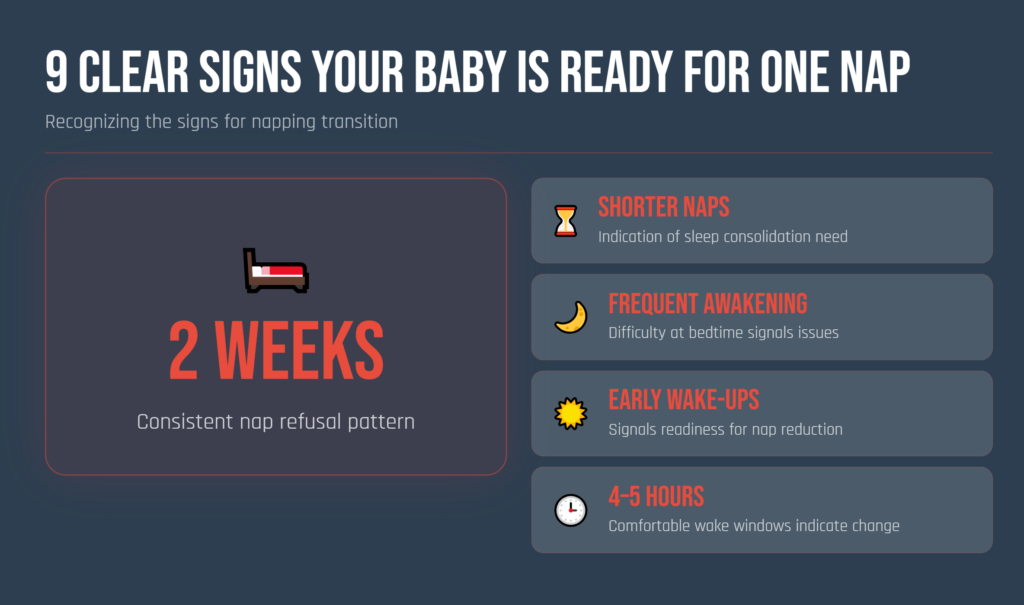
Here’s the definitive checklist. In most cases, we want to see the signs for at least 1–2 weeks consistently before deciding it’s time to transition to one nap.
Sign #1: Consistent Nap Refusal
If your baby suddenly starts fighting their morning or afternoon nap for two weeks or more despite appropriate wake windows, this could indicate readiness to transition. This resistance often looks like taking 30+ minutes to fall asleep, playing in the crib instead of sleeping, or becoming frustrated during the pre-nap routine.
According to Rachel Mitchell, a maternity and pediatric sleep specialist, if they continue to fight it for 10 to 14 consecutive days, it may be time to drop to one nap.
Sign #2: Shorter and Shorter Naps
If the second nap starts getting shorter, it could mean your baby is ready to consolidate their sleep into one longer midday nap, and drop the morning nap altogether.
When one or both naps consistently become shorter, particularly if your baby takes only a brief catnap for one of them, this may indicate they’re preparing to consolidate their sleep needs.
Sign #3: Trouble Falling Asleep at Bedtime
If your baby has trouble falling asleep at bedtime or starts waking more frequently at night after taking two good naps during the day, they may be getting too much daytime sleep for their age. According to sleep specialists at Boston Children’s Hospital, this happens because the total amount of sleep a child needs in 24 hours remains relatively constant, but the distribution changes as they mature.
Sign #4: Early Morning Wake-Ups
Earlier-than-usual morning wake-ups are a sign that it might be time to make the switch. Early wake-ups are another sign your kiddo is ready to make the switch from two naps to one.
Sign #5: Longer Comfortable Wake Windows
If your baby can comfortably stay awake for at least 4–5 hours without becoming overtired, they might be ready to drop to one nap. Babies usually drop to one nap when they can stay awake comfortably for at least 4–5 hours both before a nap and after a nap, which is 15 months old, on average.
Sign #6: Nighttime Sleep Disruptions
Suddenly waking early and/or split nights, where a child can’t sleep for long periods during the middle of the night, are signs to watch for. If your child is regularly getting less than 10 hours of sleep per night on a two-nap schedule, transitioning to one nap may help lengthen night sleep.
Sign #7: Playing Happily in the Crib
Dr. Vyas weighs in: “You will know when a baby is ready to transition when they are put down for a nap and just play in the crib for a period of time. If that happens consistently for three to five days, you can try for a one-nap schedule.”
Sign #8: Bedtime Gets Pushed Later
Bedtime gradually getting pushed later is a sign that something needs to shift. If a toddler is staying up later than their bedtime or fighting their bedtime, it’s a sign that something needs to shift in their routine. “I like looking at the 24-hour sleep cycle and seeing what’s working and what isn’t,” says Cannon, adding that a toddler fighting bedtime may be ready for one nap.
Sign #9: Content on One-Nap Days
If your baby is consistently refusing one nap for at least one to two weeks and still seems well-rested and content on days with one nap, they may be ready to transition. Being content means they’re not showing signs of overtiredness, irritability, or increased fussiness with a single nap.
🚦 Signs Your Baby Is NOT Ready Yet
Just as important as knowing when to move forward is knowing when to wait.
| Sign | What It Likely Means |
|---|---|
| Nap refusal lasting only 3–5 days | Sleep regression, not readiness |
| Increased clinginess alongside nap changes | Growth spurt or developmental leap |
| Extra hunger with nap refusal | Growth spurt |
| Learning a major new skill (walking, talking) | Developmental disruption, not readiness |
| Miserable after a one-nap day | Not yet developmentally ready |
| Night sleep worsening | Overtiredness from going to one nap too early |
“If your baby is just going through a regression or growth spurt, disruptions to sleep like nap refusal, early waking, or restlessness tend to last a few days to two weeks, and are often paired with other signs like increased hunger, clinginess, or new skills such as standing or walking.”
The key difference is consistency over time.
🔄 Is It a Sleep Regression or a Nap Drop? Here’s How to Tell
This is the question that stumps every parent at least once.
| Factor | Sleep Regression | True Nap Readiness |
|---|---|---|
| Duration | Days to 2 weeks | 2+ weeks consistently |
| Accompanying signs | Increased hunger, clinginess, new skills | None of the above |
| Mood on one-nap days | Overtired, extra fussy | Content, well-rested |
| Age | Any age | 13–18 months (typical) |
| Night sleep | Worsens temporarily | Stays stable or improves |
| Resolution | Returns to normal | Requires new schedule permanently |
The readiness to drop a nap is based on changes in sleep patterns and behavior, while the 18-month sleep regression refers to temporary disruptions in sleep that can occur around that age.
A sleep regression is a period when a baby or toddler who has been sleeping well suddenly starts waking at night and/or skipping naps. Babies become harder to settle for naps and at bedtime during this tricky period.
📋 The 2-to-1 Nap Transition: Step-by-Step
You’ve seen the signs consistently for two weeks. Your baby is in the 13–18 month range. It’s time. Here’s exactly how to do it.
The Gradual Method (Recommended for Most Babies)
In order to transition to one nap each day, we gradually shift the morning nap later and later. Doing this typically shifts the afternoon nap a bit later and shortens that nap until it’s dropped completely.
Rather than making a sudden change, a gradual transition tends to be much gentler on your baby’s body. Shift the nap 15–30 minutes later every few days until you reach your target nap time.
Gradual Transition Schedule Example
| Days | Nap Time | Strategy |
|---|---|---|
| Days 1–2 | 10:00 AM | Starting point |
| Days 3–4 | 10:30 AM | Push 30 mins later |
| Days 5–6 | 11:00 AM | Continue shifting |
| Days 7–8 | 11:30 AM | Nearly there |
| Days 9–10 | 12:00 PM | Target midday nap |
The Cold Turkey Method
Some children can handle an immediate adjustment to a one-nap schedule when the morning nap moves to the middle of the day and bedtime is earlier. This suits more adaptable babies who transition quickly without becoming overtired.
The Flip-Flop Method (Best for Daycare Babies)
To cut down on overtiredness, it can be helpful to flip-flop between one-nap days and two-nap days as your child gets used to staying awake for longer periods. This is a good option if your baby is being transitioned to a one-nap schedule at daycare before they’re ready or they seem to be getting really overtired. Offering two naps every few days, or just on the weekends, can help “reset” the sleep pressure that will build up as they adjust.
🕐 Sample One-Nap Schedule by Age
The goal with one nap is for the nap to happen about halfway through the day. This nap typically happens 5–6 hours after waking in the morning.
On a one-nap schedule, wake windows are between 4–6 hours.
13–15 Months: Just Transitioned
| Time | Activity |
|---|---|
| 6:30–7:00 AM | Wake up |
| 11:30 AM–12:00 PM | Nap begins (target: 1.5–2.5 hours) |
| 1:30–2:30 PM | Nap ends |
| 6:30–7:00 PM | Bedtime |
15–18 Months: Settled into One Nap
| Time | Activity |
|---|---|
| 7:00 AM | Wake up |
| 12:30 PM | Nap begins (target: 1.5–2.5 hours) |
| 2:30–3:00 PM | Nap ends |
| 7:00–7:30 PM | Bedtime |
18–24 Months: Extended Wake Windows
| Time | Activity |
|---|---|
| 7:00 AM | Wake up |
| 1:00 PM | Nap begins (target: 1–2 hours) |
| 2:30–3:00 PM | Nap ends |
| 7:30–8:00 PM | Bedtime |
Once your baby or toddler has adjusted, they’ll sleep 11–12 hours at night and 2–3 hours during the day, on average.
🌙 Bedtime Adjustment: Don’t Skip This Step
This is the most overlooked piece of the whole transition.
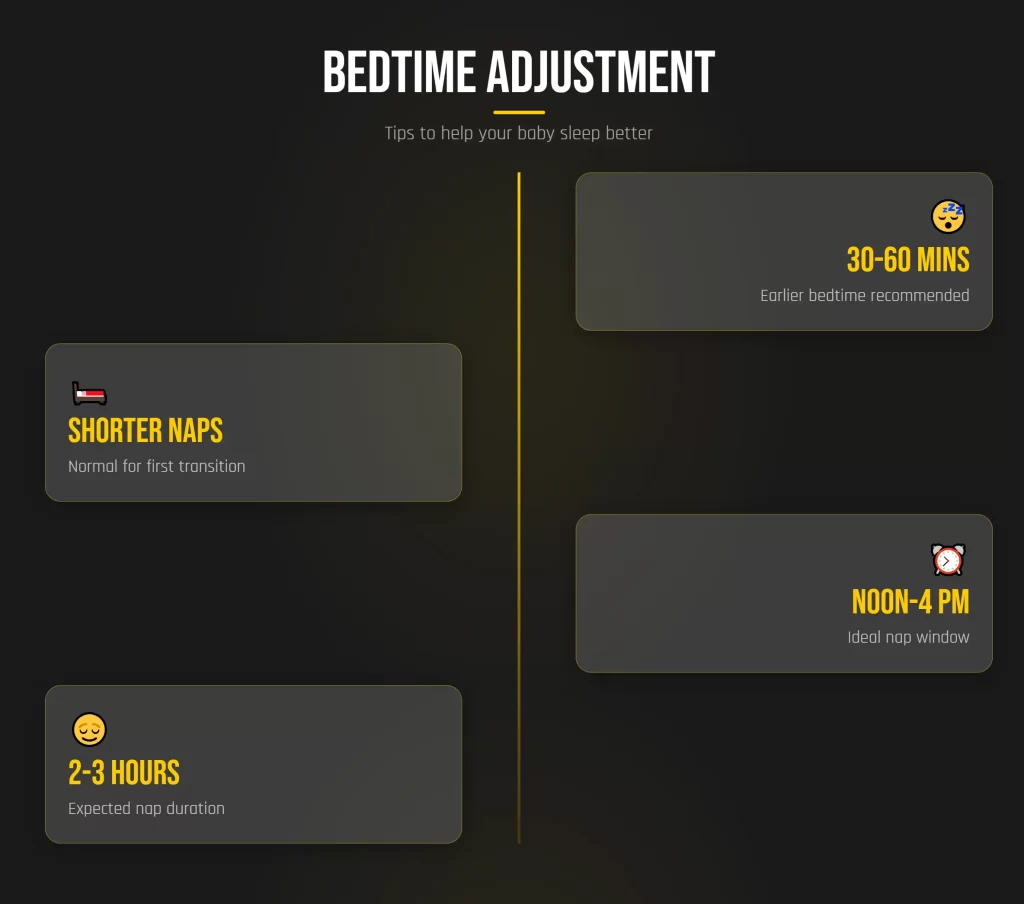
During the transition, your baby may need to go to bed in the evening 30–60 minutes earlier to prevent overtiredness.
If the second nap doesn’t happen, you should continue to offer an earlier bedtime to keep your child from getting overtired. It’s also normal for the one nap to be shorter at first.
Don’t schedule their one nap too late in the day, as it is likely to disrupt their nighttime sleep. Try to plan your baby’s nap about halfway through their day, sometime between noon and 4:00 PM. Starting the nap, which will likely be two to three hours long, between noon and 1:00 PM gives them ample time to sleep and enough awake time before bed.
⚡ What to Expect During the Transition: The Honest Truth
Some little ones transition from two naps to one fairly quickly, while others can take 2–4 weeks. During this transition, it’s common to have some days that don’t work perfectly. You may see times when naps or wake windows just don’t happen the way you planned. That’s okay; this is a normal part of the transition.
Common Challenges and Solutions
| Challenge | What’s Happening | Solution |
|---|---|---|
| Short single nap (30–45 mins) | Baby still adjusting to longer wake windows | Normal at first. It is normal for the initial transition to result in a shorter nap. Over time, the nap duration should extend and become more consistent. |
| Early morning wake-ups | Sleep pressure redistribution | Many babies experience early morning wakings during the transition because they’re still adjusting to the new sleep distribution. |
| Extra fussiness late afternoon | Overtiredness building | Move bedtime earlier by 30–60 minutes |
| Some days needing two naps | Inconsistency is normal | Some days your toddler may need two naps; other days just one. That’s totally normal for a few weeks. Keep bedtime a bit earlier on one-nap days. |
| Bouncing between one and two naps | In-between phase | Your baby may spend a few weeks bouncing back and forth between one and two naps, almost as if your little one needs one-and-a-half naps per day! This is normal. |
🛏️ How to Set Up the Perfect Nap Environment
Help your baby take a solid 2-hour nap by creating a dark sleep environment and following a consistent nap routine. White noise can be a really helpful tool here.
The American Academy of Pediatrics recommends creating a consistent sleep environment that mimics nighttime conditions and using the same pre-sleep ritual for naps that you use for bedtime.
Nap Environment Checklist
- ☑️ Room-darkening blackout curtains (total darkness signals sleep hormone production)
- ☑️ White noise machine (consistent sound masks household disruptions)
- ☑️ Cool room temperature (65–70°F is the expert sweet spot)
- ☑️ Familiar comfort object (a lovey signals sleep time)
- ☑️ Consistent pre-nap routine (same 3–4 steps in the same order every day)
- ☑️ Same nap location every day (the crib, not the car or stroller)
Thirty minutes before naptime, engage in some quiet play and put on soft white noise in the background as a subconscious clue that naptime is coming.
🧠 The Science Behind the Nap Transition
There’s real developmental biology powering every nap drop. Sleep isn’t just rest. Daytime sleep plays a huge role in your baby’s mood, brain development, and even how well they sleep at night. Well-timed naps help prevent overtiredness, which can lead to crankiness, short naps, and night waking. Getting the right amount of daytime sleep helps your baby fall asleep easier at bedtime and stay asleep longer overnight.
“Their brains are also undergoing cognitive growth, allowing them to better handle longer periods of wakefulness and regulate their emotions and energy more evenly throughout the day. Sleep patterns are becoming more adult-like, with more stable circadian rhythms and longer, more efficient sleep cycles.”
According to Dr. Nilong Vyas, pediatrician and founder of Sleepless at NOLA, naps serve a critical function by allowing children time to process things they’ve interacted with within their environment. Everything they touched, felt, heard, or saw needs to be connected with previous experiences. Neuronal connections get solidified, and their bodies grow during periods of sleep.
👶 Factors That Influence Timing
Not every baby hits this milestone on the same calendar page. Babies with higher sleep needs often hold onto two naps longer than those who need less total sleep. More adaptable babies may manage the transition earlier, while more sensitive babies might need to maintain two naps longer. Very active babies sometimes drop to one nap earlier because they can stay awake for longer stretches.
| Factor | Effect on Transition Timing |
|---|---|
| Sleep needs | High-sleep-need babies transition later |
| Temperament | Adaptable babies transition more easily |
| Activity level | Very active babies may transition earlier |
| Daycare schedule | Daycare transitions may happen at 11–12 months |
| Developmental milestones | Learning to walk often delays ideal transition timing |
| Night sleep quality | Poor night sleep suggests not ready for one nap yet |
📝 The Transition Tracker: Your 4-Week Plan
Week 1: Observation Mode
- Track exact nap times, durations, and moods daily
- Note how many nights per week baby wakes up
- Watch for consistent signs of readiness across multiple days
- Don’t change anything yet; collect data
Week 2: First Shifts
- Push the morning nap 15–30 minutes later
- Offer an early bedtime on days the second nap is refused
- Keep a short catnap option available if baby hits the wall at 4 PM
- Stay consistent with the nap environment
Week 3: Consolidation
- Continue shifting the morning nap toward midday
- Target nap time: 11:30 AM–12:30 PM
- Bedtime: adjust earlier if nap ends after 2:30 PM
- Expect some messy days; this is normal
Week 4: New Normal
- Settle into a consistent single nap at midday
- Aim for 1.5–2.5 hours of solid midday sleep
- Establish bedtime at approximately 5–6 hours after nap ends
- Expect nap duration to increase as the body fully adjusts
💡 Expert Tips Worth Printing Out
From Nicole Cannon, certified child sleep consultant:
“Usually I see it around 15 to 18 months, but often, children in daycare are transitioned to one nap once they leave an infant room, which is around the 12-month mark. As children get older, they naturally need less sleep during a 24-hour period, and that reduction usually comes from daytime sleep.”
From Huckleberry sleep experts:
Most children aren’t ready for a consistent one-nap schedule until at least 14 months of age. While some children successfully make the transition earlier, it would be unlikely that a 9-month-old would be able to get the sleep they need on a one-nap schedule.
From SleepWise Consulting:
This on-again, off-again pattern can last several weeks. Once you see a 5-day streak of consistently skipping the second nap, repeated over 2–3 weeks, that’s usually your sign that it’s time to officially transition to one nap.
From Taking Cara Babies:
The transition to one nap is usually much smoother when your little one is fully ready for it and you have the tools to navigate it.
❓ Frequently Asked Questions
My baby is 10 months and refusing naps. Is it time?
If your 10-month-old is having trouble napping, they are more likely going through the 10-month sleep regression rather than dropping to one nap. In 15+ years as a sleep consultant, only a handful of 10-month-olds have truly transitioned to one nap.
How long does the 2-to-1 transition take?
It can take a couple of weeks to a month to complete the transition from two naps to one. The transition can take up to a month as your baby adjusts to their new schedule.
My baby’s one nap is only 30 minutes. Is that okay?
It’s normal for the one nap to be shorter at first. It is normal for the initial transition to result in a shorter nap as the baby adjusts to the new schedule. Over time, the nap duration should extend and become more consistent.
My 18-month-old is still on two naps. Should I be worried?
As a general rule, most babies are ready to drop to one nap sometime between 12 and 18 months old. Your little one may wait longer to make the transition, at 19 or 20 months. Neither is a sign of rapid or slow development, so there’s no reason to consult with a doctor if your child waits until they’re almost three to drop to one nap.
What time should the one nap be?
Aim for one 2–2.5 hour nap around midday. The goal with one nap is for the nap to happen about halfway through the day. This nap typically happens 5–6 hours after waking in the morning.
My baby is in daycare on one nap but needs two at home. What do I do?
Aim for the same nap time at home on weekends as your child uses at daycare whenever possible. Keeping the timing aligned helps your child’s internal clock stay regulated, even if the sleep environment looks different.
🔑 Key Takeaways
- The typical age for the 2-to-1 nap transition is between 13 and 18 months, with the average age to switch to one nap around 14 months old
- 12 months is typically too early for one nap for most babies, regardless of what daycare or conflicting advice suggests
- In most cases, we want to see the signs for at least 1–2 weeks consistently before deciding it’s time to transition to one nap
- The biggest readiness signals: consistent nap refusal, shorter nap durations, bedtime resistance, early morning wake-ups, and the ability to stay awake comfortably for 4–5 hours
- Making the transition before your child is ready can lead to miserable days and cause nighttime awakenings
- Aim for one 2–2.5-hour nap around midday and adjust bedtime earlier during the transition weeks
- Some days your toddler may need two naps; other days just one. That’s totally normal for a few weeks.
- After transitioning fully to a one-nap schedule, we’d expect night sleep to lengthen
- Not all changing sleep cycles or patterns mean it’s time to drop a nap. In fact, it could be a pesky sleep regression that’s disturbing your baby’s sleep.
Every parent who has ever sat outside a nursery door, ear pressed against the wood, holding their breath, knows this feeling. Sleep milestones are both triumphant and terrifying. Your baby is growing. Their brain is expanding. Their world is widening. And somehow, in the middle of all that magnificent chaos, they need you to read the signs correctly and trust the process.
The single nap is coming. And when it arrives, and those midday hours stretch out in front of you, golden and quiet, you’ll know you got the timing just right. 🌙
Disclaimer: The information in this article is for educational purposes only and does not constitute medical advice. Every baby is unique. Speak to your pediatrician or a certified pediatric sleep consultant for guidance tailored to your child’s specific needs.